

Do we need a ‘New Society’?
From Quiet Desperation to Shared Vision
“The mass of men,” said Henry Thoreau, “lead lives of quiet desperation.”
Trapped in lives they did not really want, with a vague sense that surely there must be more to all this—and more to themselves. Burdened by habit, too cynical to imagine something better, too jaded to try anything new.
Unfulfilled lives are often to do with a poverty of vision. I have had my share of that quiet desperation, but have also stumbled into other possibilities...
A Taste of a ‘New Society’...
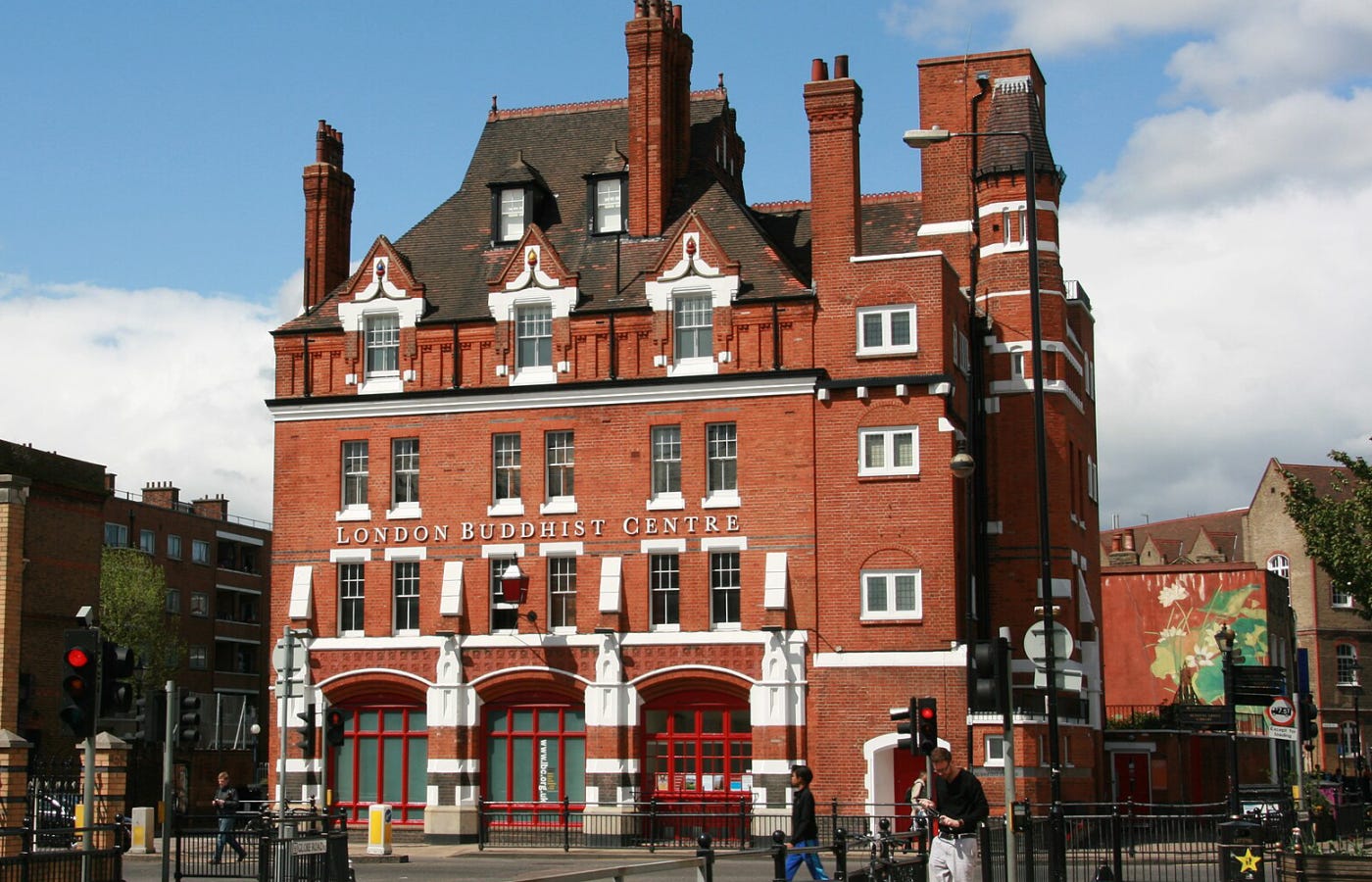
As a young man in my twenties, I started attending classes, courses and retreats, making friends at the London Buddhist Centre in Bethnal Green. I loved it. But I thought of it as a hobby, something I could do at the weekends, and nothing more than that. When I was lucky enough to lose my job, however, I went and worked at one of the cafes run as a Buddhist business, connected to the centre. Working there alongside Buddhists made all the difference; I began to catch something of the adventure of it all. I saw how this was an attempt to create a different culture. It wasn’t long before I moved into a community. I soon realised that this could be what I did with my life, rather than an ‘add-on’.
Sangharakshita’s Vision
I had found myself in the ‘Buddhist Village’ as it was called, which consisted of several communities, as well as two Buddhist-run cafes, a gift shop, a second-hand bookshop, a second-hand clothes shop, an organic food shop, an arts centre, and of course at its heart, the Buddhist Centre itself. I had not, up to that point, experienced such a sense of community based on shared values. I had stumbled into what was known in Triratna circles as ‘The Nucleus of a New Society’, a term which came from a series of talks given in 1976 by the founder of the movement, Sangharakshita.
Sangharakshita had founded Triratna in 1967. He had returned to Britain from India, where he had lived for 20 years, becoming a monk and immersing himself in learning and teaching Buddhism. He had been invited back by the small Buddhist establishment in England. The relationship didn’t work out, however, and when he was disinvited from the English Sangha Trust, he saw the opportunity to found a new Buddhist movement. He had come across Buddhist organisations, both in India and England, which were run by people who weren’t committed Buddhists, who didn’t realise the radical possibilities Buddhism offered. He knew that at the heart of this movement would be an Order, made up of people who had made a commitment to the Dharma central to their lives. The Order would also be neither monastic nor lay, with ‘commitment as primary, lifestyle secondary’.
Despite these principles, he didn’t have a complete vision of what the movement would become, how it would manifest. One of Sangharakshita’s aphorisms is: “You learn what you are doing in the process of doing it**,**” and this was very much the case here.
Over the next few years, he attracted a number of young men and women who would learn meditation and the principles of Buddhism. This was the sixties and seventies, a time of great social change, and people were ready to try new things. In going on retreat together, these youngsters discovered that when in the right conditions—in the natural beauty of the countryside, practising meditation, puja (Buddhist ritual), and learning the principles of Buddhism—unseen vistas and possibilities in themselves and between each other would reveal themselves.
When they got home, they were sorry to part, and wanted to continue living together. In this way, communities began to form.
Naturally they also wanted to work together—it being an area where so much time and energy was spent, often misspent, in meaningless drudgery with people who didn’t share their values. Why not also integrate work into one’s Buddhist life? Businesses began to spring up as well.
By 1976, after nearly a decade of these experiments, a vision began to crystallise for Sangharakshita, and he gave a series of four talks themed ‘Buddhism for Today and Tomorrow’. These talks were called
‘A Method of Personal Development’,
‘A Vision of Existence’,
‘The Nucleus of a New Society’
‘Blueprint for a New World’
These talks laid out a vision of an ‘economic and social network, built up in order to provide the best conditions for human growth.’1
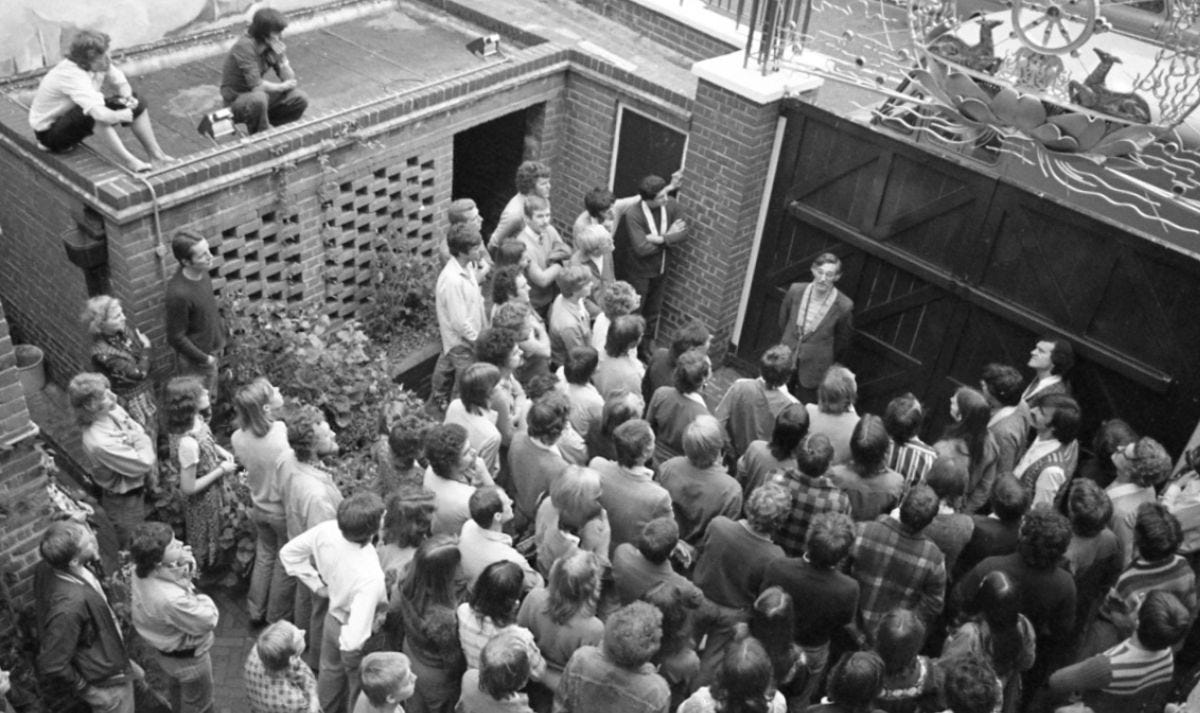
Around the time of these talks, enthusiasm and idealism were high, even a sense of history - Buddhism was coming to the West and anything was possible. Things moved very quickly – the three ‘C’s; Centres, Communities and Co-Operatives (businesses) sprang up in different parts in the world, and it was possible for some to take part in each of these three, to live in a ‘world within a world’.
An incredibly successful example of a ‘Co-Operative’ or Team-Based Right Livlihood, was Windhorse Trading, founded in 1980. Starting as a market stall selling giftware imported from India, it became a large business which by 1997 was employing 190 Buddhists with a turnover of £10 million. Profits from the business went to buying new buildings for centres in several cities around the UK. Buddhists came from different countries to experience life in a Buddhist-run business, and train for ordination. There were Evolution shops in many cities England.
Perhaps in no better place has this vision been lived out than in Bethnal Green around the the old fire station converted into a Buddhist Centre, which opened in 1978 - incidentally the year I was born. In the early 2000s, as well as reading about this vision as laid out in these talks from 1976, I was also having a taste of it. Having not had a great experience of work and house-sharing in London before that, feeling a bit battered and bruised from the experience, I felt I had escaped the ‘rat race’. I was making lifelong friends, meeting people from all over the Triratna world, growing personally and having a great time. My own sense of freedom and growth, coincided with a feeling that I was contributing to something, was part of something, that was having a good impact on the world. I didn’t feel like like I was being a ‘good person’ or ‘making a difference’ - a phrase I dislike - it was just that my personal growth and enjoyment coincided with being part of and contributing to a community.
Not a Political Theory
Despite using terms like ‘Co-Operatives’ and “Give what you can, take what you need” similar to the Marxist creed “From each according to his ability, to each according to his needs.”, the vision behind a New Society is in no sense political. There is no plan to overthrow governments or seize power, the use of power in terms of forcing or coercing people to do things against their will being anathema to the spirit of Buddhism. There isn’t a political wing to the movement. It’s more like friends coming together, inspired by the Dharma with the idea “Wouldn’t it be great to live together.” or “Wouldn’t it be great to work together.” thereby integrating home life and work life into Buddhist practice, creating a culture based on shared Buddhist values and mutual support.
A Pure Land
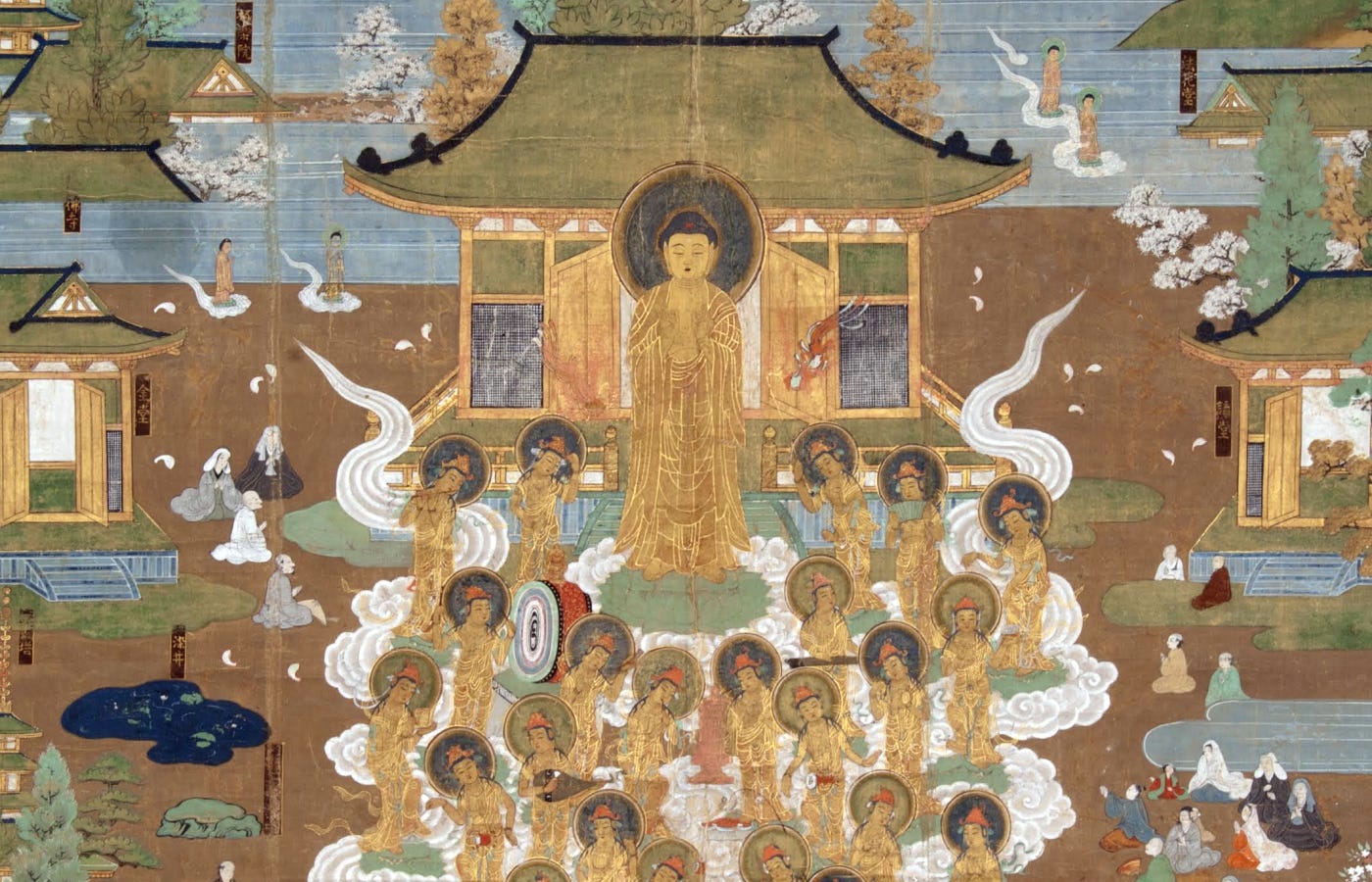
There is also a deeper, more mythic relevance for this community. Its real name is not the ‘London Buddhist Centre’, but Sukhavati (the Land of Bliss). Sukhavati is a timeless, blissful Buddhist realm where the conditions are perfect for practising Buddhism. This realm is presided over by the Buddha Amitabha, who sits in the main shrine room of the London Buddhist Centre.
So on one level, we have the London Buddhist Centre as a registered Charity, with a collection of employees, and associated propeties that are rented out, as a legal entity. But on a deeper, more imaginative, in a sense truer reality, it is an attempt to realise Sukhavati, a Pure land where everything is a meaningful expression of ultimate reality. This is living a ‘holy’ life; in that the etymology of holy is linked to ‘whole’—one’s whole life is connected up to one’s highest values, and, to my mind, represents the most fulfilling and meaningful way to live.
This need not only be limited to those who live and work there, but all who contribute and come into contact with Sukhavati. I have seen this played out with the London Buddhist Centre; not everyone is able to, or wants to live in a community, or work in a Buddhist business, but they can nevertheless benefit from and take part in the community, take part in the myth.
With this mythic dimension in mind, one’s life is enveloped in a deeper meaning, one’s everyday actions, seemingly mundane and administrative, are really contributing to the creation of a ‘pure land’. There is a correspondence with one’s everyday life with the transcendental. “As above, so below.” This is the most fulfilling way to live, to my mind.
The Shadow of the ‘New Society’
Living in community, working at the centre I soon started training for ordination - I had dived in head-first. Some of my family and friends understandably worried I had been snared by a cult, but I knew that this was nothing of the sort, there was never any pressure on me to do anything I didn’t want to and I was free to leave when I wanted.
But little did I know, I was coming to the party a bit late. In the community as a whole, enthusiasm in those talks given twenty-five years or so ago, was beginning to dwindle. Many of the first wave of Order members who had set up the communities and businesses were now older, and some had lost their radical idealism, and didn’t want to live in shared rooms in communities anymore, or work for ‘support’ in TBRLs. That and changing economic and cultural factors meant some businneses and communities closed. A Guardian article which criticised Sangharakshitas sex life had sent waves through the movement, and the certainty about the ‘New Society’ had begun to dwindle.
Another factor was perhaps what had happened at the Croydon Centre. It had been one of the leading lights in the community - an exciting example of what was possible - it had a hugely successful centre, restaurant and arts centre. But it was spearheaded by a charismatic order member who’s motives were not pure. There was a culture of bullying and pressure to conform. The situation has become a cautionary tale in the movement of when idealism tips over into something else.
One way or another, the optimism and radicalism of the sixties and seventies faded somewhat, and many of the businesses closed- including Windhorse, which closed in 2010. People stopped talking so much about the New Society…
The ‘New Society’ Today
I’ve heard people say that the vision of a ‘New Society’ has had its day — that it belongs to another era, a relic of a more idealistic or naïve time. I don’t agree.
There is also a growing sense today that something has gone badly wrong in Western civilisation. Many people point to the loss of any deeper vision of life — the increasing secularism that leaves us materially comfortable perhaps, but spiritually disoriented. As the Biblical proverb says: “Where there is no vision, the people perish.”
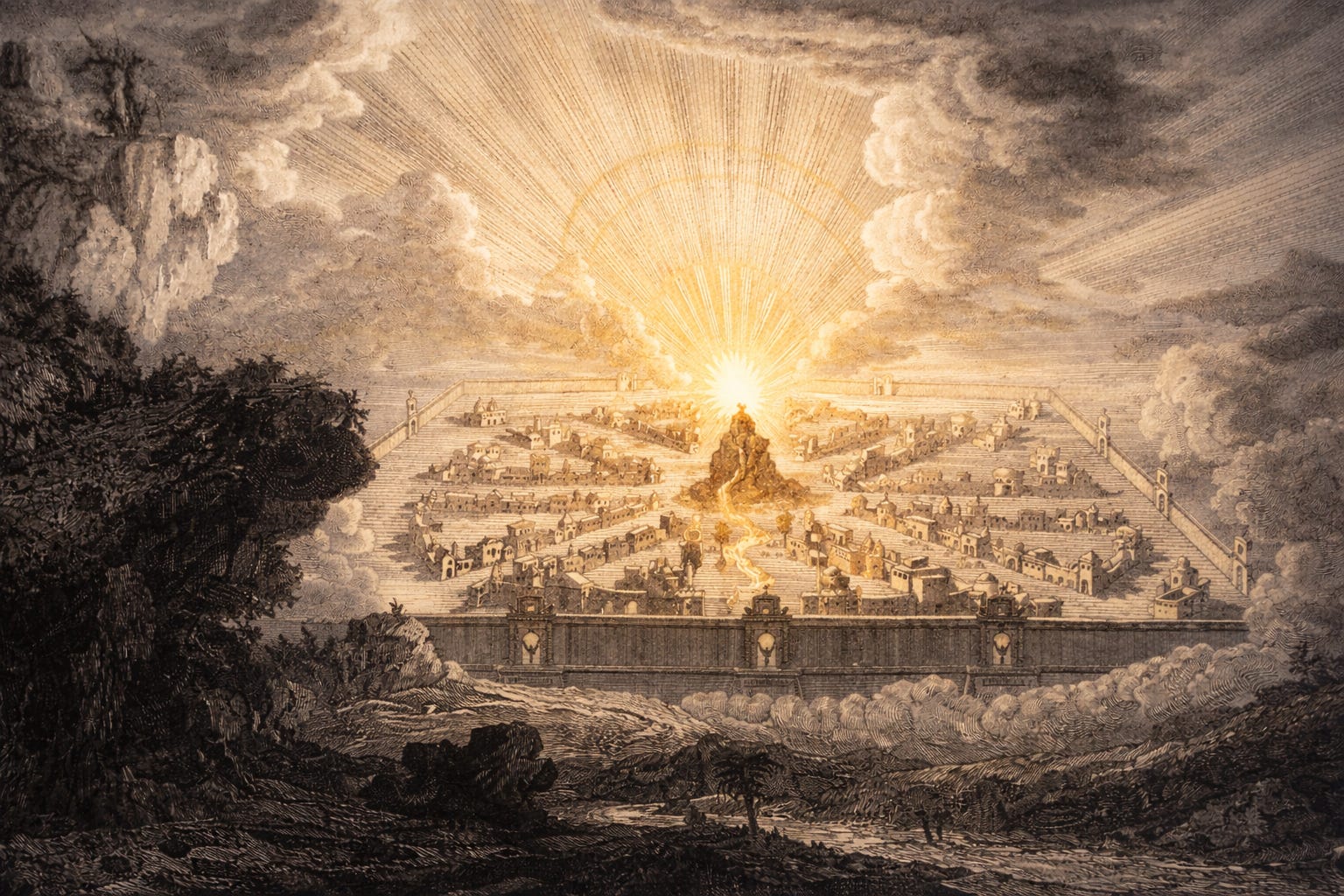
The needs that the ‘New Society’ responds to have not disappeared. If anything, they have become more urgent. Human beings still need friendship, meaning, inspiration, and a way of living that supports our deepest aspirations - and most of all, a spiritual dimension to life, a connection with something transcendental.
When I was younger, I think I imagined that the New Society would eventually take over the world. It seemed so obvious to me that it made sense — surely once people heard about it they would want to join in! With time I have learned that it doesn’t quite work like that. In a seminar, Sangharakshita once remarked that there is “no final victory for the New Society.” Samsara2 goes round and round without end. Perhaps only a handful of people in each generation manage to ascend the spiral path and escape it altogether. Buddhism simply isn’t everyone’s cup of tea. People are very different; some people will throw themselves into the Dharma with their whole lives. Others may practise it seriously alongside the other commitments of life. Some may connect with it more lightly — dropping in from time to time. And many people will not feel drawn to it at all.
At its heart, the New Society runs on two things: inspiration in the Dharma and friendship. Whenever those conditions are present, the possibility of the New Society is alive — and the possibility that some magic might happen.
Samsara: the eternal cycle of birth, death, and rebirth in which beings wander due to craving, ignorance, and karma, characterised by fundamental unsatisfactoriness (dukkha).
A nice survey of the topic, and great to have some of your own experiences on record!
While I agree that the idea of the New Society ‘taking over the world’ isn’t going to wash for most of us, I also think there’s some merit in thinking in terms of an ‘objective’ - even if provisional, even an upaya - something to aim at, something to focus our collective energy. Do you agree, and if so what might that objective be?
Another hit! Great piece Aryajit!