

Slowing Time with Asangha
Buddhist reflections on time and space (and dogs)

One of the things I like doing in life is hearing stories/ myths/ legends and then exploring the meanings. I think this is because great stories have wisdom and reveal patterns in the nature of reality. Ideally this exploration is done with other people- as other people bring different ideas and viewpoints that I could never think of on my own.
I don’t think there is one ‘correct’ meaning for a story- nor that interpretations of a great story are exhaustible.
The Buddhist tradition does of course have many great stories and legends- so today I’d like to look at a story then we can see what themes come up for us:
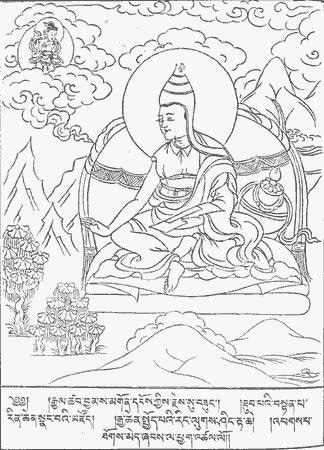
This legend about Asangha, one of the founders of the Yogachara school of Buddhism, who lived in the 4th century in India:
Are you sitting comfortably? Then I’ll begin....
The Story of Asangha and Maitreya
After many years of intense study of Buddhism in a monastery, unsatisfied with his realisation, Asangha decided he needed to do some practice, so went to live in a cave- determined to meditate until he saw Maitreya- who is the Buddha of the future, who’s name means ‘the kindly one’.
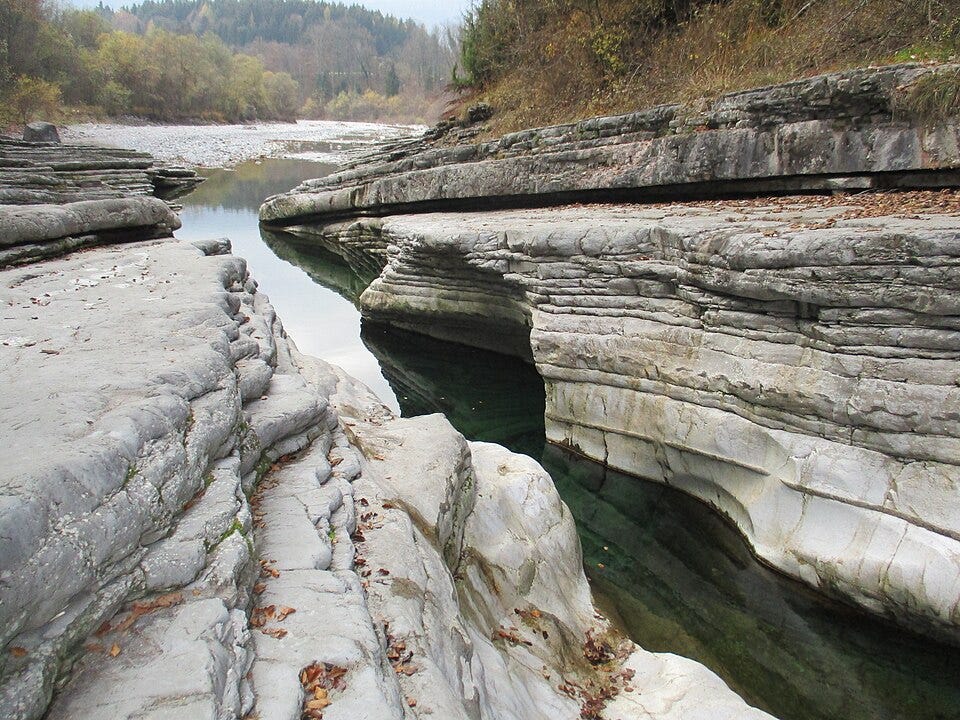
After 6 years of meditation, he has still not met Maitreya, so he gives up and leaves his cave. On the way back to the monastery, he sees how a stream of water has gently but persistently worn down a rock after many years. Inspired to apply this gentle persistence and patience to his meditation practice he returns to the cave.
After three more years he gives up again, having still not seen Maitreya, and leaves the cave. This time he sees a man making a needle by stroking a stone with some cotton wool, inspired by the patience of this man he goes back to the cave once more.
Finally, after three more years, he gives up for the last time, and heads home. On the way back this time, he encounters a injured dog, who has a painful gash in his leg, in which there are maggots crawling. Filled with compassion, he gets on his hands and knees to remove the maggots with his tongue, so as not to hurt the dog. At that moment, Maitreya appears before him.
Asangha is delighted to see him but can’t help blurting out: “Where have you been! All those years meditating in the cave and you didn’t appear…”
“I was there all the time.” said Maitreya “You just couldn’t see me because you hadn’t yet developed selfless compassion. If you don’t believe me, carry me through the town and see who can see me.”
Asangha then carries Maitreya through the town on his shoulders, and only an old women can see part of Maitreya’s legs and the dog.
Maitreya transports Asangha to the Tusita Heaven, where he stays studying the Dharma for ‘50 earth years’, returning with the 5 Teachings of Maitreya…
I will now give you my thoughts on this story. Before reading on, stop for a moment and see what you take from this story- what themes and incidents in it resonate with you? (feel free to put any observations and reflections you have in the comments below)
The Path and the Goal
When he retreats to his cave, Asangha is determined to see Maitreya, but has no success for 12 years. It is significant that Maitreya is the Buddha of the future- it’s like Asangha is leaning into the future, grasping at a future version of himself. Perhaps it is this that is getting in the way of him being able to see Maitreya. This is one of those annoying problems of the spiritual life- we want to achieve enlightenment, make a breakthrough, but that wanting can itself be an obstacle. It is only when Asangha gives up, goes for a walk, and forgets himself in compassion for the dog, that Maitreya appears.
Does this mean that Asangha has been wasting his time for the past 12 years? That instead of meditating in a cave he should have been wandering round looking for injured dogs? I suspect not- I think he probably needed those 12 years to burn through his mental hindrances, purify his mind and to develop compassion. It seems unlikely we can have a breakthrough with our ordinary minds; full of anxiety, stress, delusion etc. But it points to an interesting problem in the spiritual life- applying more effort, putting more time in, isn’t always the answer.
Sangharakshita has some interesting things to say about this dilemma:
“Enlightenment is not reached by following a path. But this doesn’t mean that the path should not be followed. Paradoxically enough, you follow the path knowing that it doesn’t lead anywhere...Not even the ‘right’ path will take us to enlightenment. The path, one may say, is in the dimension of time, while the goal is in the dimension of eternity. We will never reach eternity by going on and on in time.”
I find it slightly annoying that reality is like this- that from the point of view of the unenlightened mind, reality is paradoxical; it is outside space, outside time- and therefore not understandable on the level of the rational mind, it cannot be pinned down with words or concepts. It reminds me of those ‘magic eye’ pictures that looked like a mess, then after a while you relaxed your focus and then an image emerged- I could never see those pictures- no matter how much I strained!
Sangharakshita always stressed that although the goal may not be reached by following the path, the path still has to be followed; like a spaceship trying to escape the earths gravity, we need to build an immense rocket of effort, and expend lots of energy, before we can relax and enjoy weightlessness- floating around, eating floating liquid food, and weeing into a space bottle. We need to train like a astronaut about to go into space, we need the gentle persistence of water wearing down rock over many years.
It seems like straining isn’t the answer though. Breakthroughs, paradigm shifts, seem to come after a period of intense practice, when we relax and go for a walk or something. Think of Archimedes getting into his bath, or Newton sitting under a tree. We need to build in periods of relaxation where we drop effort for a while, to create the conditions for insights to arise. But the intense study/ practice needs to come first- the path needs to come before the goal.
Perception of Time
When Maitreya takes Asangha up to the ‘Tusita Heaven’ the story says that he stays there for ‘50 earth years’- suggesting that time is experienced differently there- what does this mean?
Tusita heaven is one of the several higher realms in Buddhist cosmology- which are equivalent to higher mental states- this is where Maitreya is said to reside. You can’t get there by travelling in a car, or even a spaceship- but by raising your level of consciousness. Time flows differently there - time is experienced much more slowly- so that what would have felt like 50 earth years to Asangha in the Tusita heaven, would have actually been 3 hours in earth time. We don’t have to take this literally- we may prefer to think of Asangha having a very inspired experience lasting three hours, which formed the basis of his later teaching.
I often relate to time like it is something I am always short of- so I race even faster to try and get things done- which is not a very nice way to live. It feels like the worse state of mind I’m in- the less time I have. It is better is when I take my time, don’t rush things and do things carefully- it puts me in a better state, and I seem to get more done.
Breaking the Bonds of time and space...
I remember leading a class in which I was teaching newcomers the Metta Bhavana. In my introduction to the practice I said “You can break the bonds of time and space with this practice.” I’m probably not qualified to make such a claim, having not ‘broken the bonds of time and space’ myself! Nevertheless, intuitively I believe the statement to be true...
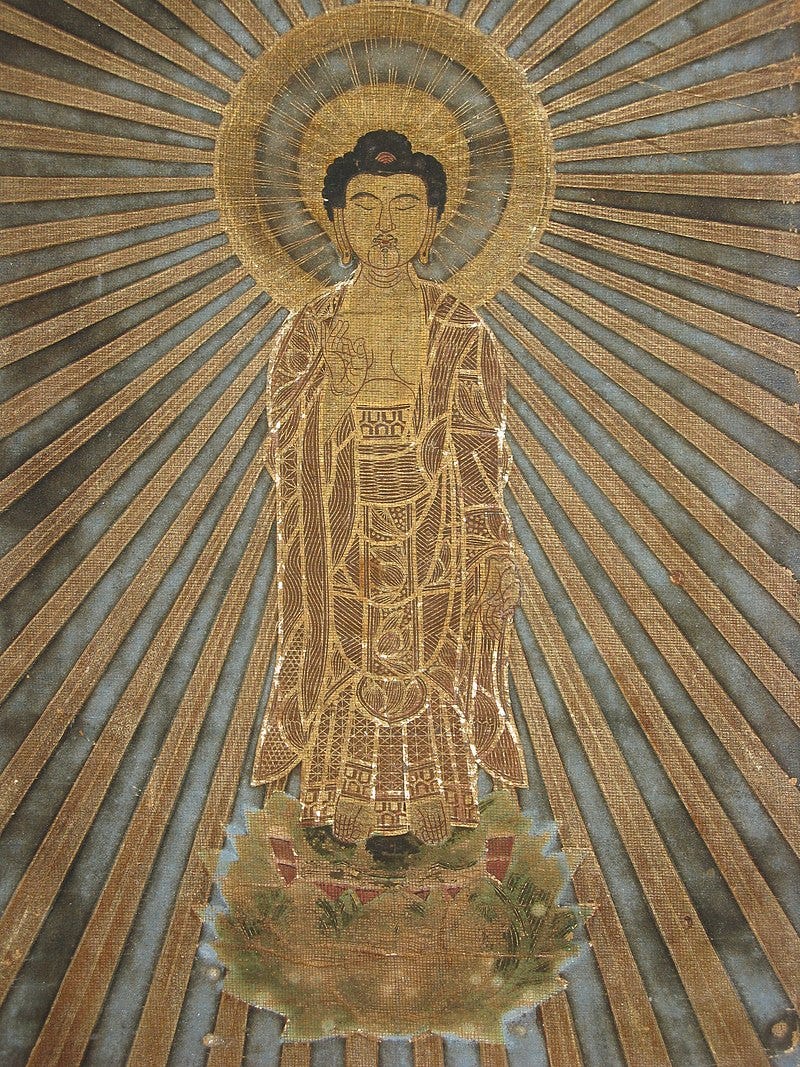
My statement suggests that we are trapped in time and space and that to break out of the prison of these dimensions would be a good thing. I’m sure the Buddhist tradition would agree with me on this- (in fact its probably where I got the idea from). Enlightenment is said to be outside time and space. This is epitomised by Amitabha/ Amitayus- the same Buddha with two different names- the first meaning infinite light (analagous to infinite space) and the second infinite life (analogous to infinite time) - we can take ‘infinite’ to indicate having stepped outside time/space.
The Metta Bhavana is a practice in five stages in which you cultivate good will towards yourself, a friend, a neutral person an enemy and then in the final stage- all beings everywhere. In the practice you are stretching your sphere of concern from yourself to include more and more people and beings, until you’re including the all beings everywhere. From a metaphysical point of view you could say you are dissolving the objective and the subjective- our sense of I’m here and the rest of the world is out there- and so breaking the bonds of space- and if you break the bonds of space you also break the bonds of time- they are interwoven (according to clever people like Einstein).
I have to say although I find it interesting to reflect on time and space, it does make my head hurt after a while, trying to get my head round these things. When my head starts hurting I take it as a sign I should ease up a bit. Maybe I should go for a walk.
I guess the main point of Asanghas story is that Maitreya was there all along, Asangha needed to forget himself and experience selfless compassion, to see the future Buddha Maitreya and to enter the Tusita heaven.
I like the fact that it was a dog that prompted Asangha’s compassion. No doubt its a dog because dogs in some cultures, are seen as lowly creatures, even impure creatures. I’m glad to say thats not the case in England, where dogs are treated like kings. Where I live in Hertford there is a shop called ‘Margaux’s’ which is an upmarket shop that calls itself a ‘lifestyle store for dogs’! That’s fine by me- I think dogs are one of life's joys.

So I will finish by saying we should all do the Metta Bhavana-which is for all beings- including dogs- because we really will break the bonds of time and space…
Thankyou Aryajit, another wonderfully insightful essay!
This reminds me of the moment the Buddha to be realises that self mortification is not the way to enlightenment. He spends years practicing, meeting many different teachers, none ultimately giving him the answer he is searching for. Then, the practice of self mortification, he does this to the point of near death, but then stops, takes nourishment again, relaxes and takes rest, allowing the memory of his experience under the rose apply tree to arise.
We have to walk the path, and make the effort, but also know when we need to take our foot off the accelerator and gentle apply the brakes, getting that balance between the two. This being the first stage of the Metta Bhavna in action!
Thanks Aryajit. This was most helpful. I look forward to seeing you in Southampton soon. X